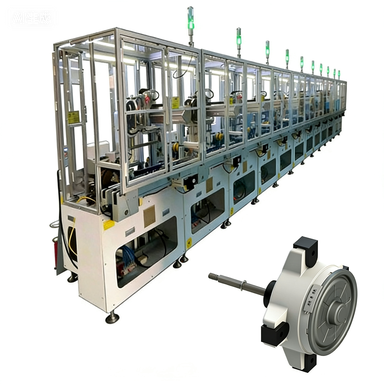
Brushless DC motors have become a key component in many modern electrical and mechanical systems. Their combination of efficiency, compact construction, controllability and relatively low maintenance makes them suitable for applications ranging from industrial automation and robotics to electric mobility, cooling systems and household equipment. As demand for these motors increases, manufacturers need production processes that can deliver accurate results at scale. Bldc motor winding machines are central to this effort because they automate one of the most important stages of motor construction: forming and placing the copper windings inside the stator.
A BLDC motor may look relatively simple from the outside, but its internal winding arrangement requires considerable precision. The number of turns, wire size, coil position and winding pattern all influence the motor’s electrical characteristics. Modern winding equipment helps manufacturers control these factors while reducing production variation and improving manufacturing speed.
The Role of Windings in a BLDC Motor
A BLDC motor normally contains permanent magnets on its rotor and electromagnetic windings positioned on the stator. Electronic circuitry controls the current supplied to the stator phases, creating a rotating magnetic field that interacts with the rotor magnets.
The winding arrangement must be carefully matched to the motor’s electrical design. Factors such as the number of stator slots, rotor poles, phases and desired operating characteristics determine how the copper conductor should be positioned.
During production, the wire is guided through the stator slots and formed into a defined pattern. The process needs to maintain accurate turns and appropriate tension. If one coil contains too many or too few turns, or if the winding is positioned incorrectly, the motor may not deliver the expected performance.
This is why winding is not simply a matter of wrapping copper wire around a component. It is a controlled manufacturing operation requiring accurate mechanical movement and reliable process parameters.
Maintaining Consistent Wire Tension
Wire tension has a significant influence on winding quality. If the conductor is too loose, the finished coil may not be compact or stable. If tension is excessive, the conductor or its insulation may become damaged.
Modern winding systems use controlled wire-feeding mechanisms to maintain suitable tension throughout the process. The wire travels through guides and tensioning components before reaching the stator, allowing the machine to regulate its movement.
Consistency is particularly important when producing a large batch of identical motors. If tension varies significantly between stators, the finished coils may have different physical and electrical characteristics.
High-quality winding equipment therefore combines controlled feeding with programmed machine movement. Together, these features help create more consistent stator windings.
How Winding Machines Work
The basic purpose of a winding machine is to guide a conductor through a predetermined path while controlling the number of turns and the position of each winding. Modern systems can use programmable controls to define the complete winding sequence.
Depending on the machine type, a needle, flyer or another specialised winding mechanism moves the copper wire around or through the stator. The machine coordinates its movement with the rotation or positioning of the stator to create the desired winding pattern.
The number of turns can be controlled electronically. Once the specified count is reached, the system can stop or move to the next section of the winding process. This provides a level of repeatability that can be difficult to achieve through manual production.
Advanced systems may also monitor wire breaks and other abnormal conditions. If the conductor breaks during winding, the machine can detect the problem and alert the operator. This prevents damaged or incomplete windings from continuing through the production line unnoticed.
Different Machine Designs for Different Motors
Not all BLDC motors use the same stator construction, so winding machinery must be selected according to the motor design.
Needle winding equipment is commonly used for stators where the wire needs to be inserted into slots in a controlled sequence. It can be suitable for compact designs and configurations requiring accurate wire placement.
Flyer winding equipment uses a rotating winding element to guide the conductor. It can provide high production speeds and may be useful for manufacturers producing large quantities of similar motors.
Some systems are designed for concentrated winding, in which coils are placed around individual stator teeth. Others are suitable for distributed winding arrangements where conductors are spread across multiple slots.
The correct choice depends on several factors, including stator geometry, wire diameter, winding pattern, production volume and required automation level. Manufacturers should consider the complete production process rather than focusing on winding speed alone.
Benefits of Automated BLDC Motor Winding
Automation provides several advantages to motor manufacturers. One of the most important is repeatability. A programmed winding system can follow the same process for each stator, helping reduce variations in coil dimensions and wire placement.
Production efficiency is another benefit. Automated equipment can perform repetitive winding operations quickly, allowing manufacturers to increase output without proportionally increasing manual labour.
Automation can also reduce operator workload. Instead of manually controlling every winding movement, operators can supervise the equipment and concentrate on material handling, quality inspection and production monitoring.
Modern bldc motor winding machines can also support multiple production recipes. This allows a manufacturer to store winding parameters for different motor models and switch between products when necessary.
However, automation must be properly managed. Incorrect machine settings can produce large numbers of defective components quickly. Operators therefore need appropriate training, and machines must be calibrated and maintained regularly.
Quality Checks After the Winding Process
Quality inspection is essential after a stator has been wound. The first step may involve visual inspection to identify loose wires, damaged insulation, incorrect coil positioning or other visible defects.
Electrical testing can then provide additional information. Measuring winding resistance can help determine whether the coils have been produced consistently. Differences between phases may indicate an issue that requires further investigation.
Other tests may be performed depending on the motor’s design and manufacturing requirements. These can include inductance measurements and checks of electrical continuity.
Automated inspection systems can make these checks faster in high-volume production environments. Test results can be compared automatically with predetermined limits, allowing defective units to be separated from acceptable products.
Recording test data digitally can provide another advantage. Manufacturers can analyse production results over time and identify patterns that may indicate problems with machinery, materials or process settings.
Factors to Consider When Choosing Winding Equipment
Selecting suitable bldc motor winding machines requires a detailed understanding of the motor models being produced. Stator dimensions should be considered first because the machine must physically accommodate the component.
Wire diameter is another important factor. Fine wire requires careful tension control and smooth handling, while thicker conductors may require stronger feeding and forming systems.
Manufacturers should also evaluate production volume. High-volume operations may benefit from automated production lines with integrated loading, winding and testing. Smaller manufacturers may prefer flexible systems that can handle different products without extensive reconfiguration.
Machine programming capabilities can be valuable for companies producing several motor models. A system that allows operators to store and recall different winding recipes can reduce setup time and improve production consistency.
Technical support and maintenance are also important. Winding equipment contains mechanical and electronic components that require regular servicing. Easy access to replacement parts and qualified technical support can reduce downtime.
Applications Driving Demand for BLDC Motors
BLDC technology is increasingly used across a wide range of industries. Electric mobility is one important area, where compact and efficient motors are required for various drive and auxiliary applications.
Robotics and industrial automation also rely on brushless motors for controlled movement. Their characteristics make them suitable for systems where reliable and precise operation is important.
Fans, pumps and cooling equipment use BLDC motors because efficient operation can be valuable when equipment runs continuously. Consumer products and household appliances may also incorporate brushless motor technology.
The growing use of BLDC motors means manufacturers need production equipment that can handle different motor designs while maintaining consistent quality. Flexible winding systems can help companies respond to this demand.
Future Developments in Winding Technology
The next generation of winding equipment is likely to become more connected and intelligent. Sensors can monitor machine movement, wire tension and other production parameters, providing manufacturers with greater visibility into the winding process.
Digital systems can record production information and help identify deviations. This can support quality improvement and make it easier to trace problems back to particular machines or production batches.
Predictive maintenance is another area with significant potential. By analysing machine operating data, manufacturers may identify wear before it leads to an unexpected breakdown. This can reduce downtime and improve production planning.
Automation may also expand beyond winding itself. Robotic systems can load and unload stators, transfer components between stations and assist with inspection. When these systems are integrated effectively, manufacturers can create highly efficient production lines.
Sustainability will remain important as well. Precise wire handling can reduce conductor waste, while accurate winding can lower the number of defective components that need to be remanufactured or discarded.
A Strong Foundation for Modern Motor Manufacturing
The winding stage has a major influence on the quality and performance of a BLDC motor. Accurate conductor placement, controlled tension and consistent turn counts help establish the electrical characteristics required by the motor design.
Modern bldc motor winding machines provide manufacturers with the tools needed to achieve these requirements efficiently. They combine precise mechanical movement with electronic control, automated monitoring and repeatable production processes.
As BLDC motors continue to expand into electric mobility, automation, robotics, appliances and industrial systems, reliable winding technology will become increasingly important. Manufacturers that combine advanced machinery with skilled operators, careful inspection and effective maintenance can create a production environment capable of delivering consistent, high-quality brushless motors for a wide range of applications.